Bordered letter paper
3/8 in, 23 lines
Wide lines inside a fine double border, for letters, notes and stories. Add a title and your name, pick a color, then print.
For letters, cards and final drafts. PDF prints Letter; the second button prints A4 or A5.
3/8 in, 23 lines
Wide margins only
31 lines on Letter
1/2 in lines, green
Fine lines and border
18 lines, folds once
Writing paper is for the things you keep: letters, thank-you notes, stories and poems. Wide lines, generous margins and a fine double border make a handwritten page look finished before you start.
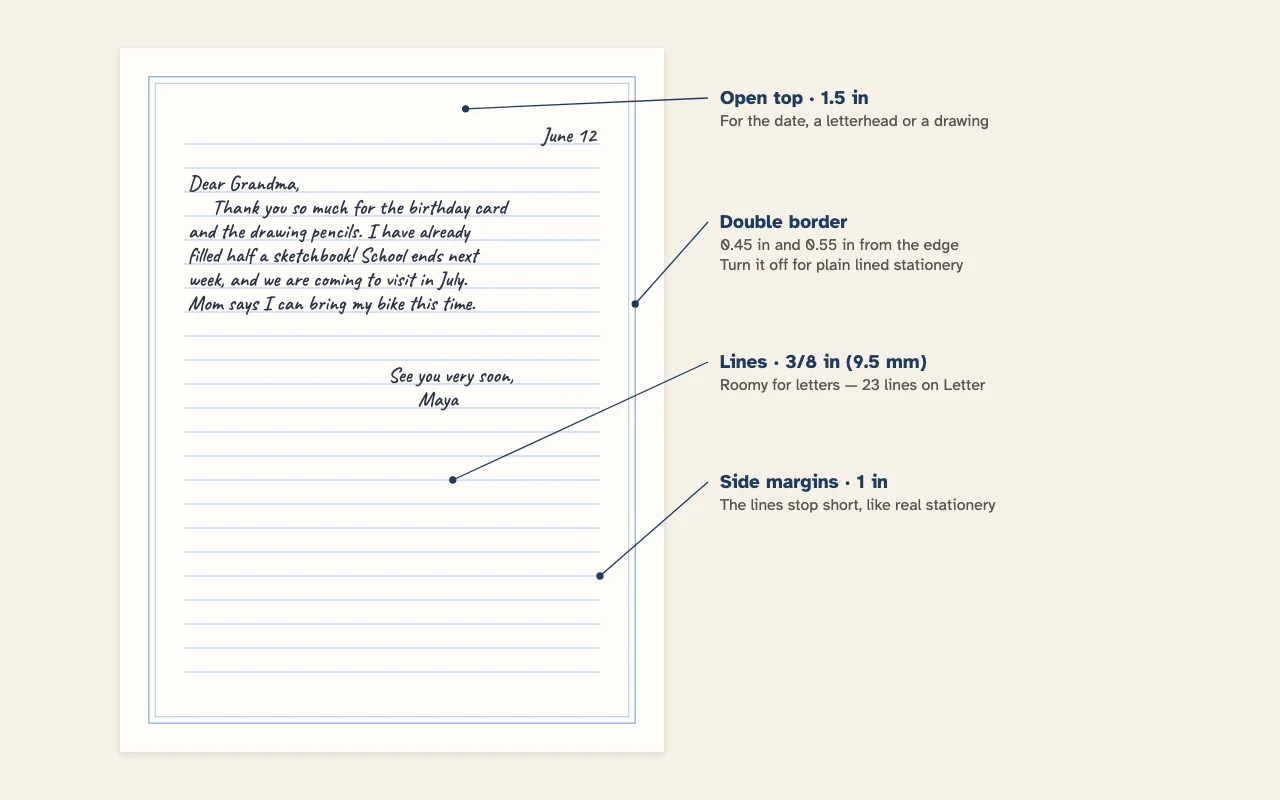
Writing paper leaves out everything a notebook page uses for school. There is no red margin, no name and date line and no hole guides. In their place:
| Part | Position | Notes |
|---|---|---|
| Outer border | 0.45 in from each edge | Thicker line |
| Inner border | 0.55 in from each edge | Thin line, so the pair reads as a frame |
| Title | Centered at the top | Optional; type it under the preview |
| Your name | Top right, level with the title | Optional |
| First line | 1.5 in from the top | Room for a date or greeting above |
| Side margins | 1 in on both sides | Lines never touch the border |
On A5 and Half Letter the side and bottom margins tighten to 0.6 inch and the first line moves up to about 1.1 inches, so a small card still has room for a real message.
Letters read better with a little more space than notes, which is why the sheet starts at 3/8 inch. Change it with the arrows next to Line spacing.
| Spacing | Lines on Letter | Lines on A4 | Good for |
|---|---|---|---|
| 9/32 in · 7.1 mm | 31 | 33 | Long letters, small handwriting |
| 11/32 in · 8.7 mm | 25 | 27 | Everyday letters |
| 3/8 in · 9.5 mm | 23 | 25 | The default, relaxed and easy to read |
| 7/16 in · 11.1 mm | 20 | 22 | Large handwriting, older readers |
| 1/2 in · 12.7 mm | 18 | 19 | Children’s letters, short notes |
Line counts are lower than on wide ruled paper at the same spacing because the first line starts lower and the bottom margin is a full inch. That space is part of the look: a letter with white space around it reads as a letter, not a homework page.
The border and lines always share one color, so whatever you pick the page looks designed rather than assembled. Light blue is the classic letter color; gray suits formal notes; lilac and green work for cards. Use the color picker for an exact shade that matches an envelope or a wedding scheme.
Line weight changes the border too: Fine gives a delicate frame for letters, Bold a stronger one for a classroom display. To make a plain page, untick Border and keep the wide margins.
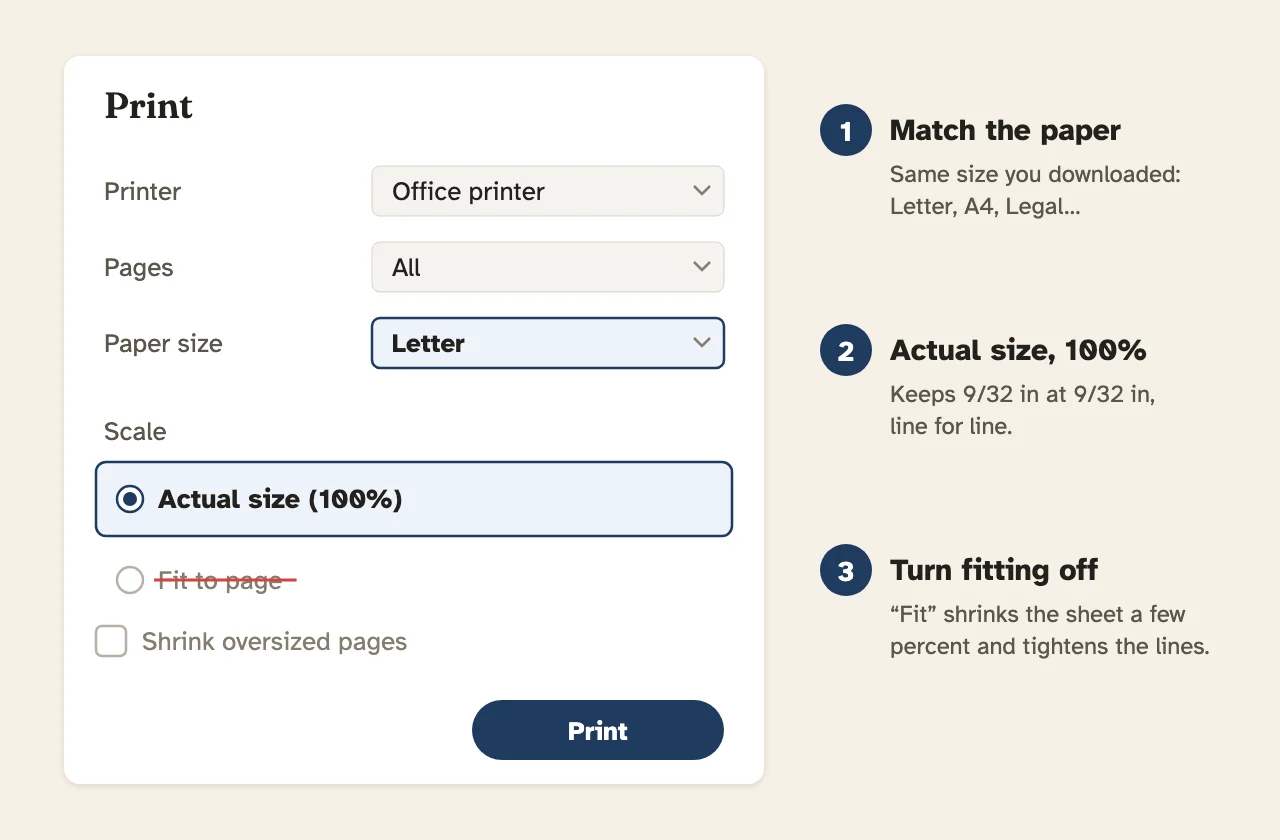
Writing paper is worth printing on something better than plain copy paper. 24 lb or 28 lb (90–105 g/m²) paper takes fountain pen ink without bleeding and feels like real stationery. For cards, light card stock works in most printers through the manual feed. Choose the matching size, print at Actual size (100%), and check the first sheet before printing a set.
If you are writing on a laptop first and copying by hand later, keep the draft on college ruled paper and save the bordered sheet for the final copy.
Writing paper, or letter paper, is lined paper made for letters and finished pieces rather than notes. It has wider margins than notebook paper, no holes or red margin line, and often a decorative border.
This page starts at 3/8 inch (9.5 mm), a little wider than wide ruled, which gives a relaxed, readable letter. A Letter sheet holds 23 lines. Use the arrows to go from 5 mm up to 1/2 inch.
Yes. Untick Border under Line weight, margin, extras. The lines keep their one-inch side margins, so the page still looks like letter paper.
Yes. Type it in the Title field and it is printed centered at the top of the page, above the first line. Your name, if you add one, is printed at the top right.
Light blue and gray are the classic choices for letters. Lilac and green suit cards and children’s stationery. The border is drawn in the same color as the lines, so the page stays in one color.
Yes. Choose 1/2 inch spacing for 18 big lines on Letter, a good size for a child’s first letters to grandparents. Children still learning letter size do better on handwriting paper with a dashed midline.
Load the paper in your printer’s manual feed tray, choose the matching size here, and print at Actual size. Most home printers take card stock up to about 65 lb (176 g/m²); check your printer’s manual.
Yes. Set Pages to the number you need. Turn on Page numbers so the reader keeps them in order. The title and border print on every page.