College ruled notebook
34 lines, three holes
Blue lines, a red margin, name and date, and hole guides that match a three-ring binder. College, wide or narrow ruled, on Letter or A4.
Every version has hole guides. PDF prints Letter; the second button prints A4 with two holes.
34 lines, three holes
28 lines for younger students
39 lines, small writing
For double-sided printing
Softer lines, less ink
For a clipboard or folder
This is the sheet in every school binder: light blue lines, a red margin, a line for your name and date, and three holes down the side. Print as many as you need, punched where your binder expects them.
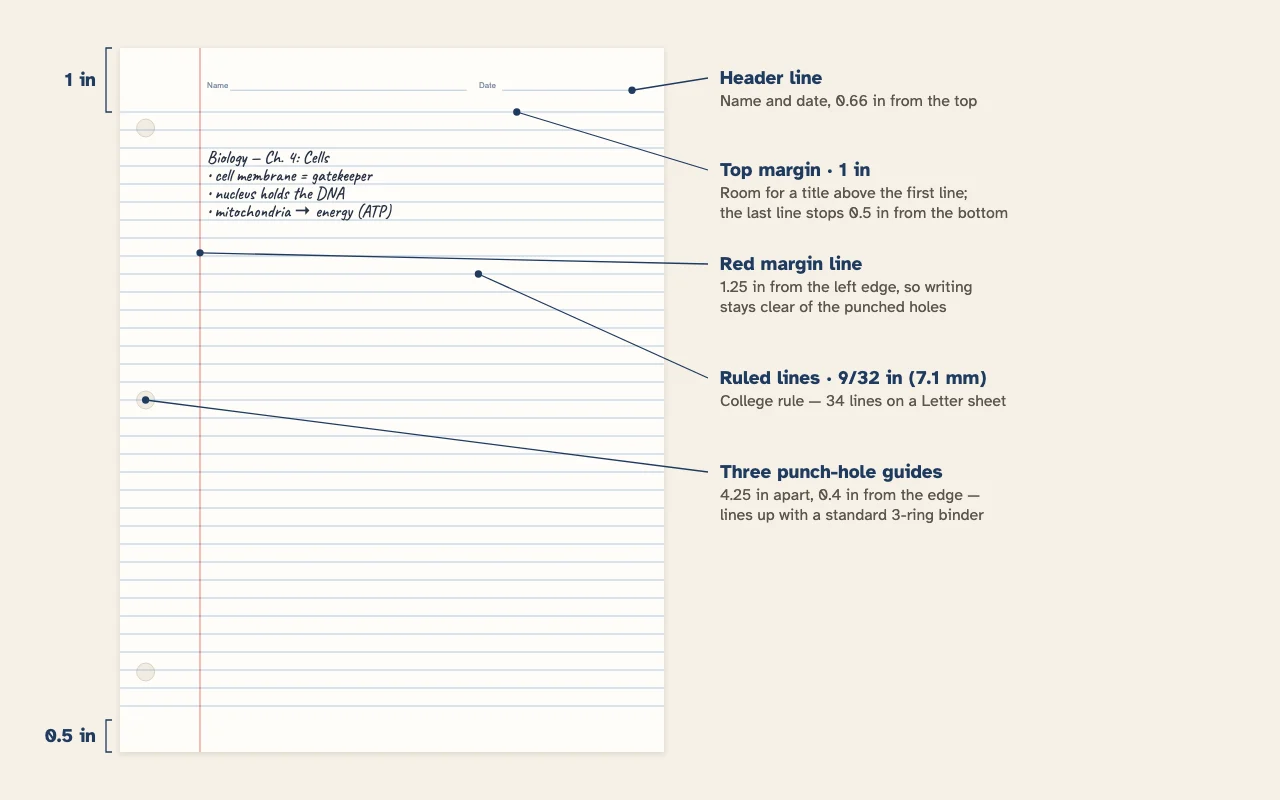
Filler paper from a store follows a pattern so settled that most people never notice it. The generator draws the same parts at the same positions:
The hole guides follow the binder standard for each paper size, so the punched sheets sit straight on the rings.
| Paper size | Holes | Spacing | Distance from edge |
|---|---|---|---|
| Letter, 8.5 × 11 in | 3 | 4.25 in apart | 0.4 in |
| Legal, 8.5 × 14 in | 3 | 4.25 in apart, centered | 0.4 in |
| Oficio, 8.5 × 13.4 in | 3 | 4.25 in apart, centered | 0.4 in |
| Half Letter, 5.5 × 8.5 in | 3 | 2.75 in apart | 0.4 in |
| A4, A5 and A3 | 2 | 80 mm apart | 12 mm |
To punch, put one printed sheet on top of a stack of blank-backed copies, line the guides up in an adjustable punch, and punch the stack together. On a single-hole punch, center the punch on each circle. In landscape the guides move to the top edge, for a flip-over binder or a clipboard.
| Ruling | Lines on Letter | Usually for |
|---|---|---|
| Wide ruled, 11/32 in | 28 | Elementary school, grades 2–5 |
| College ruled, 9/32 in | 34 | Middle school to university |
| Narrow ruled, 1/4 in | 39 | Small handwriting, dense notes |
School supply lists usually name the ruling, so match the list. If a child is still learning to size letters, notebook paper is the wrong place to start; handwriting paper with a dashed midline comes first. Older students who want a study layout instead of plain lines can print the Cornell notes template and punch it using a notebook sheet as the guide.
Printed notebook paper is ordinary copy paper, so it tears at the holes faster than heavier store-bought filler. A few things help:
For letters or journals you would rather not punch, writing paper gives wider margins and a border instead of holes.
Light blue is the color of most filler paper because it guides the pen without competing with the writing. If your printer makes it too faint, choose the darker blue or switch Line weight to Bold. Gray at Fine weight is the most economical for big print runs. Whatever you pick, the margin line stays red so the page still reads as notebook paper.
Notebook paper, also called filler paper or loose-leaf paper, is a ruled sheet made for a ring binder: light blue lines, a red margin line on the left, a header line for name and date, and holes on the left edge.
On Letter, the three hole guides are 4.25 inches apart and 0.4 inches from the edge, the standard spacing for US three-ring binders. On A4, A5 and A3 the generator prints two guides 80 mm apart, the usual European two-hole spacing.
No printer can cut holes. The sheet shows small circles where the holes go. Line them up in a hole punch, or punch through the circles one at a time.
Both exist. This page starts on college ruled, the most common. Switch to wide ruled with the wider arrow next to Line spacing, or use the Wide ruled notebook card.
A college ruled Letter sheet printed here has 34 lines. Wide ruled has 28 and narrow ruled has 39. The hole guides do not change the line count.
Yes. Untick Hole marks under Line weight, margin, extras. You can also remove the name and date line or the red margin for a plainer page.
Yes, but the holes must stay on the same physical edge. Set Margin to Both sides and print with flip on long edge; check the first sheet before printing a stack.
Standard 20 lb (75 g/m²) copy paper works for pencil and ballpoint. Use 24 lb (90 g/m²) if you write with gel pens, or if the sheets will be turned often in a binder.
Yes. Pick gray, green, lilac, black or blue for the ruled lines, or open the color picker for any color. The margin line stays red, like store-bought paper.