Isometric, 1/4 inch
34 columns, 40 rows on Letter
Equilateral triangles for drawing in 3D. Choose 1/4 inch, 5 mm, 1 cm or 1/2 inch, lines or dots, then download a true-size PDF. Free, no sign-up.
Lines and dots in the four sizes people use most. PDF prints Letter; the second button prints A4.
34 columns, 40 rows on Letter
Corners only, fades under ink
Fine grid for detailed parts
Block shapes for younger students
Big drawings and game maps
Wide scenes and long objects
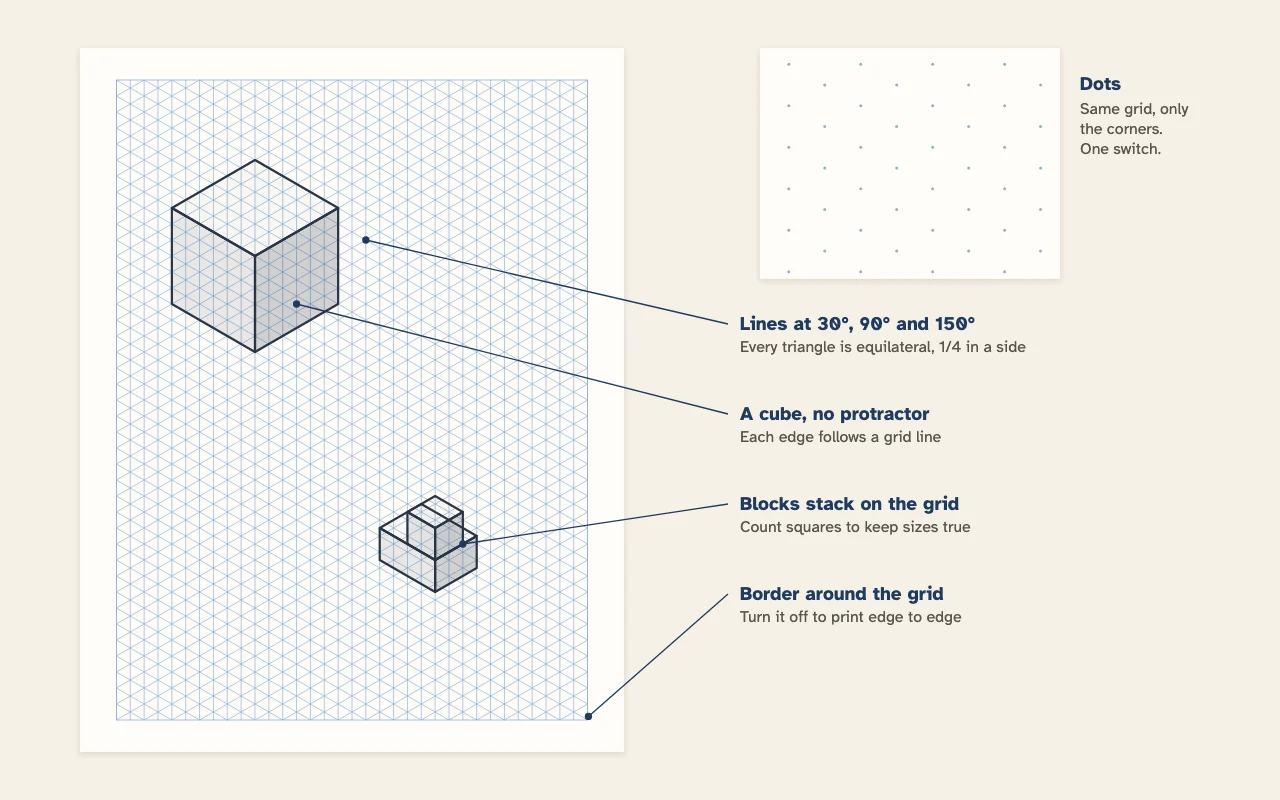
Isometric graph paper turns a flat sheet into a 3D drawing board. Its lines run along the three edges of a cube, so anything you draw along them stands up off the page. Pick lines or dots and the triangle size, then print it at true size.
An ordinary grid has two directions. An isometric grid has three: vertical lines, plus lines rising 30 degrees to the right and 30 degrees to the left. Together they cut the sheet into equilateral triangles, and each set of lines stands for one axis of a three-dimensional object: height, width and depth.
| Triangle side | Vertical lines apart | Columns × rows on Letter | On A4 | Good for |
|---|---|---|---|---|
| 5 mm | 4.3 mm | 43 × 50 | 42 × 54 | Detailed parts and small objects |
| 1/4 in · 6.35 mm | 5.5 mm | 34 × 40 | 33 × 42 | Most class exercises and sketches |
| 10 mm · 1 cm | 8.7 mm | 21 × 25 | 21 × 27 | Block shapes, younger students |
| 1/2 in · 12.7 mm | 11 mm | 17 × 20 | 16 × 21 | Big drawings to color, game maps |
Columns are the strips between vertical lines; each row is one triangle side tall. The triangles are measured along their sides, which is the length you count when drawing an edge.
Start with the edge closest to you. Draw it straight up a vertical line, as many spaces tall as the object. From the bottom of that edge, run one line up and to the left along the 150 degree direction and one up and to the right along the 30 degree direction. These are the bottom edges of the two visible faces. Repeat from the top of the first edge, add the back verticals, and close the top face.
A few habits keep drawings clean:
On this paper, every edge along the three axes is drawn at full length, which is called an isometric drawing. A strict isometric projection shrinks those edges to about 82 percent, because the real object is tilted away from you; drafting classes sometimes use a special scale for it, but on grid paper the full length is the norm and the shape looks the same.
Isometric views are not perspective. Parallel edges stay parallel and objects do not shrink toward a vanishing point, so you can measure any edge along an axis from the drawing. That is why engineers and furniture makers like them for assembly sketches, and why they are the usual partner to front, top and side views in technical drawing.
For square grids, go back to graph paper. Dot grid paper has the square version of the dot layout, and engineering paper covers the orthographic views that often sit next to an isometric sketch.
Isometric graph paper is a grid of equilateral triangles. Its lines run in three directions, vertical and 30 degrees either side of horizontal, which are the three axes of an isometric drawing. Draw along them and boxes, buildings and machine parts come out in 3D without measuring angles.
Mostly for drawing objects in three dimensions: technical drawing and design class exercises, product sketches, room and building views, isometric game maps and level designs. It is also used in geometry for cube nets and counting the volume of block shapes, and in quilting and tile design for triangle and hexagon patterns.
One-quarter inch or 5 mm triangles suit most drawings on a Letter or A4 sheet. Pick 1 cm or 1/2 inch for younger students building block shapes, or for large sketches you want to color in. Use the square size arrows to step between 5 mm, 1/4 inch, 10 mm and 1/2 inch.
The lines run at 30, 90 and 150 degrees from the horizontal, so every pair of crossing lines meets at 60 or 120 degrees and every small triangle is equilateral. The 90 degree lines are the vertical edges of whatever you draw; the 30 and 150 degree lines are its width and depth.
Yes. Isometric paper, isometric grid, triangle paper and triangular graph paper all describe the same sheet of equilateral triangles. Some versions turn the grid so the lines run horizontally instead of vertically; for 3D drawing you want the vertical lines, which is how this generator prints it.
Yes. Set Draw as to Dots, or use the Isometric dots card. The dots sit at the corners of the triangles, so the grid guides your pencil but disappears from the finished drawing. Dot paper is popular for final drawings and for teaching, because children connect dots to build shapes.
Pick a point and draw a vertical edge three spaces long. From its top and bottom, draw edges three spaces along the 30 degree line to one side and the 150 degree line to the other. Close the top face with two more edges and add the two back verticals. Shade one face to make it read as solid.
For hand-drawn isometric maps and tabletop dungeon layouts, yes. Most isometric pixel art in games uses a 2:1 pixel step, which is about 26.6 degrees rather than the true 30 degrees on this paper, so it suits planning and sketching more than tracing sprites pixel by pixel.
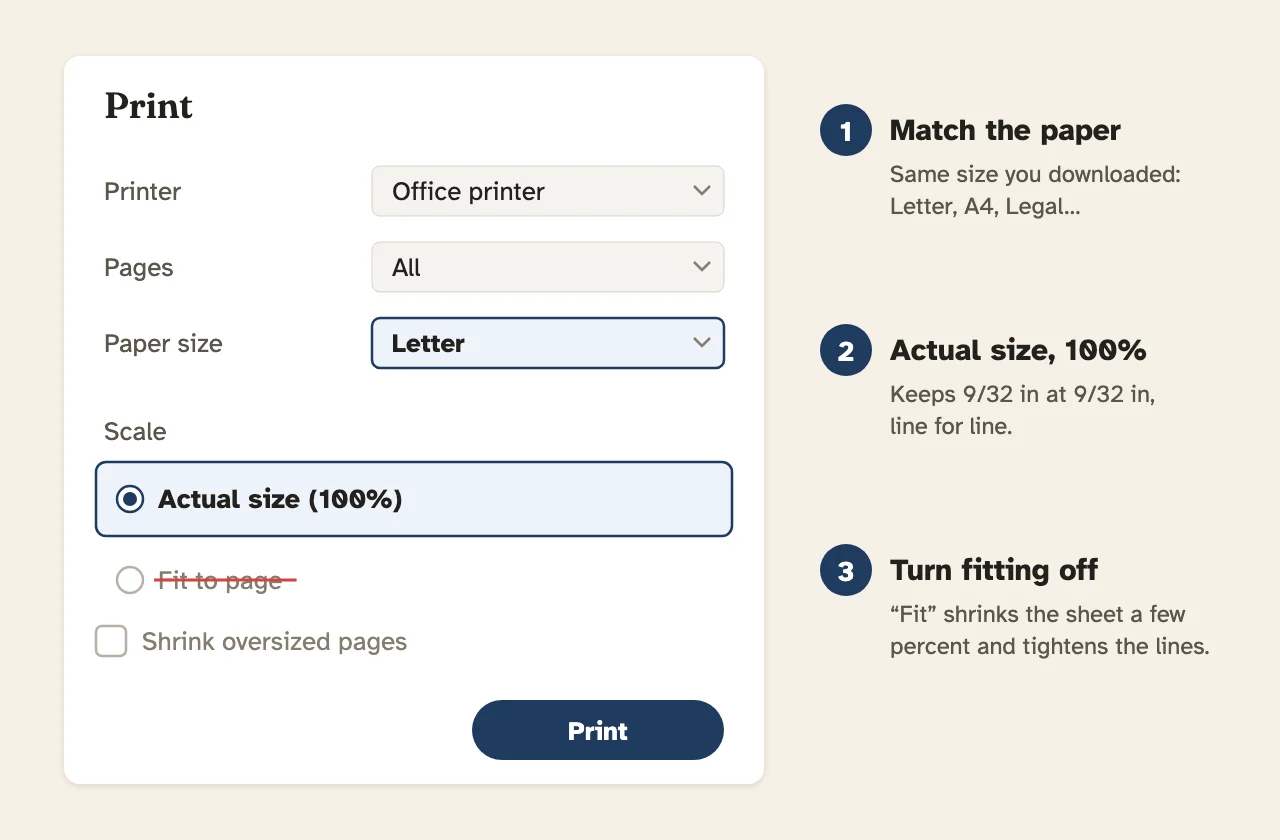
Yes. Use the A4 button on any card, or pick A4 in Paper size. The triangles keep their exact size and the generator fits whole rows and columns inside half-inch margins, with an optional border around the grid.