Narrow ruled
Red margin, name and date
Lines 1/4 inch (6.4 mm) apart for small handwriting and dense notes. 39 lines on Letter, 41 on A4. Set it up, then download a true-size PDF.
Tight rulings for small writing. PDF prints Letter; the second button prints A4 or A5.
Red margin, name and date
Full-width lines
Quiet on a dense page
41 lines on Letter, 44 on A4
49 lines for tiny writing
29 lines for planners
The left strip is narrow ruled at 1/4 inch. Try a few words against it before you print a stack.
1/4 in · 6.4 mm
Small, neat handwriting
9/32 in · 7.1 mm
Most students and offices
11/32 in · 8.7 mm
Large handwriting
Letters touching the line above? Move up to college ruled.
Narrow ruled paper puts lines 1/4 inch apart, so a single Letter sheet holds 39 of them. It is the ruling for small handwriting, study sheets and anyone who wants more on a page.
| Paper size | Narrow ruled lines | 6 mm lines | 5 mm lines |
|---|---|---|---|
| Letter, 8.5 × 11 in | 39 | 41 | 49 |
| A4, 210 × 297 mm | 41 | 44 | 52 |
| Legal, 8.5 × 14 in | 51 | 53 | 64 |
| A5, 148 × 210 mm | 29 | 30 | 36 |
| Half Letter, 5.5 × 8.5 in | 30 | 31 | 37 |
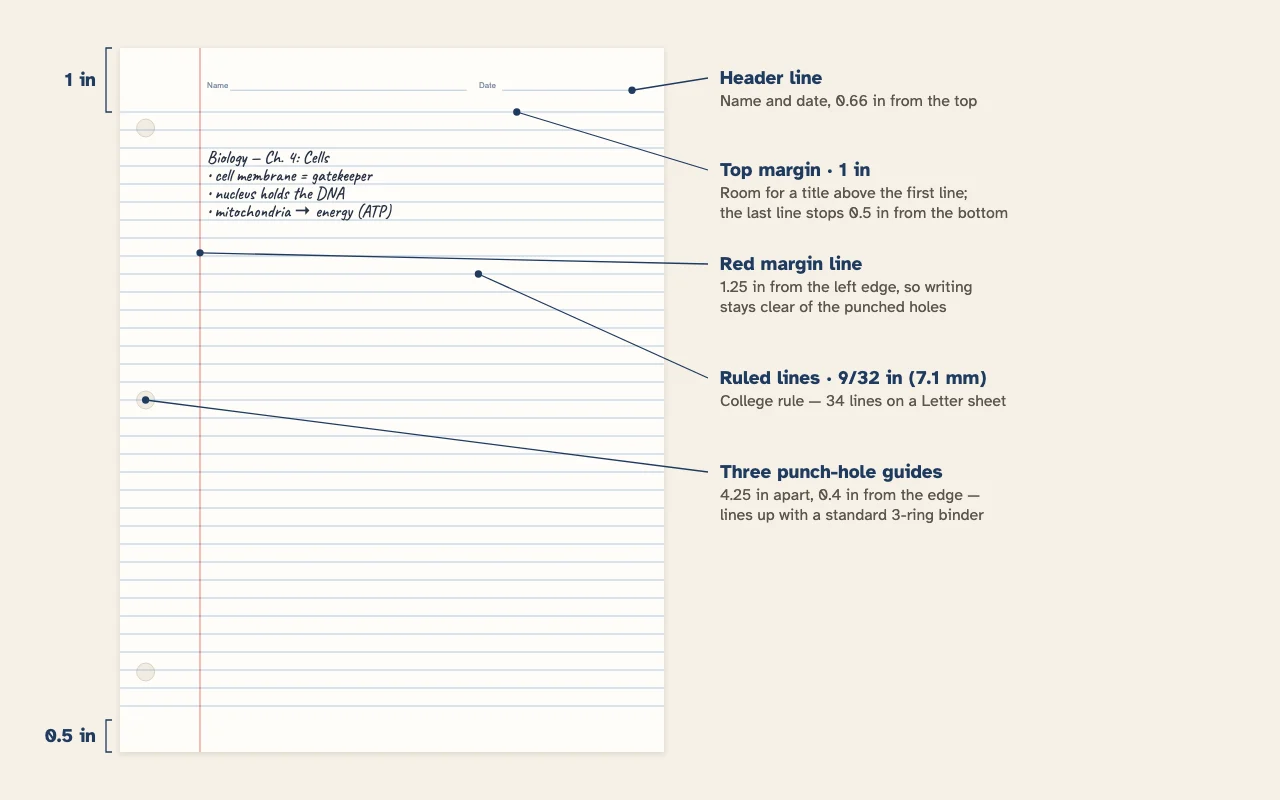
Every sheet keeps the same one-inch top margin and half-inch bottom margin as the other rulings on this site, so the extra lines come from the spacing alone. To check your printer, measure ten lines: on narrow ruled they span exactly 2 1/2 inches, or 63.5 mm.
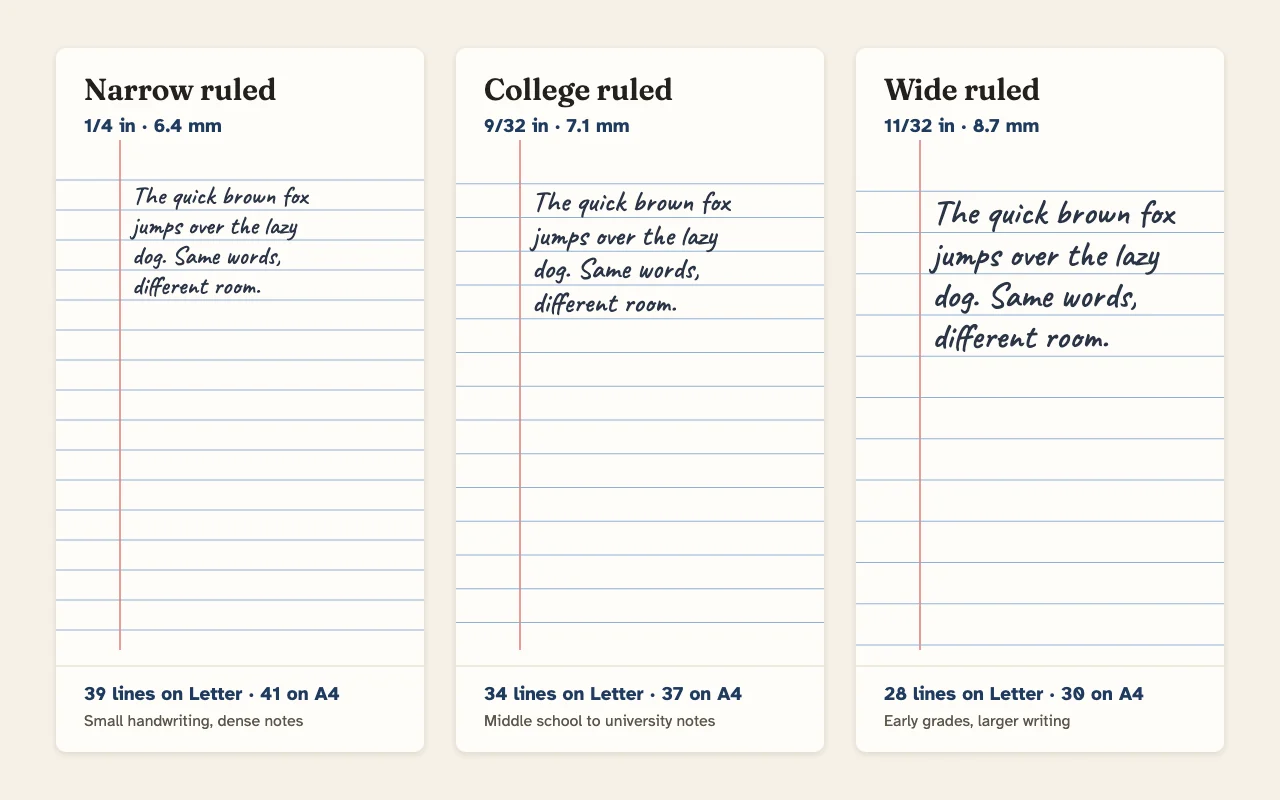
Narrow ruling suits a specific hand. A good test: write a few words on the narrow strip above, holding your pen as you normally would. If the tops of your tall letters (b, d, h, k, l) stay below the next line with a little air above them, narrow ruled will work. If they touch or cross, you will be fighting the paper all day; college ruled paper is one standard step wider, and wide ruled paper two.
The pen matters as much as the hand. A 0.38 mm or 0.5 mm gel pen, a fine mechanical pencil or a fine fountain pen nib all leave a stroke thin enough for 1/4 inch lines. A ballpoint at 1.0 mm or a felt-tip marker usually needs wider ruling.
The risk with narrow ruling is a page that looks like a wall of lines. A few settings help:
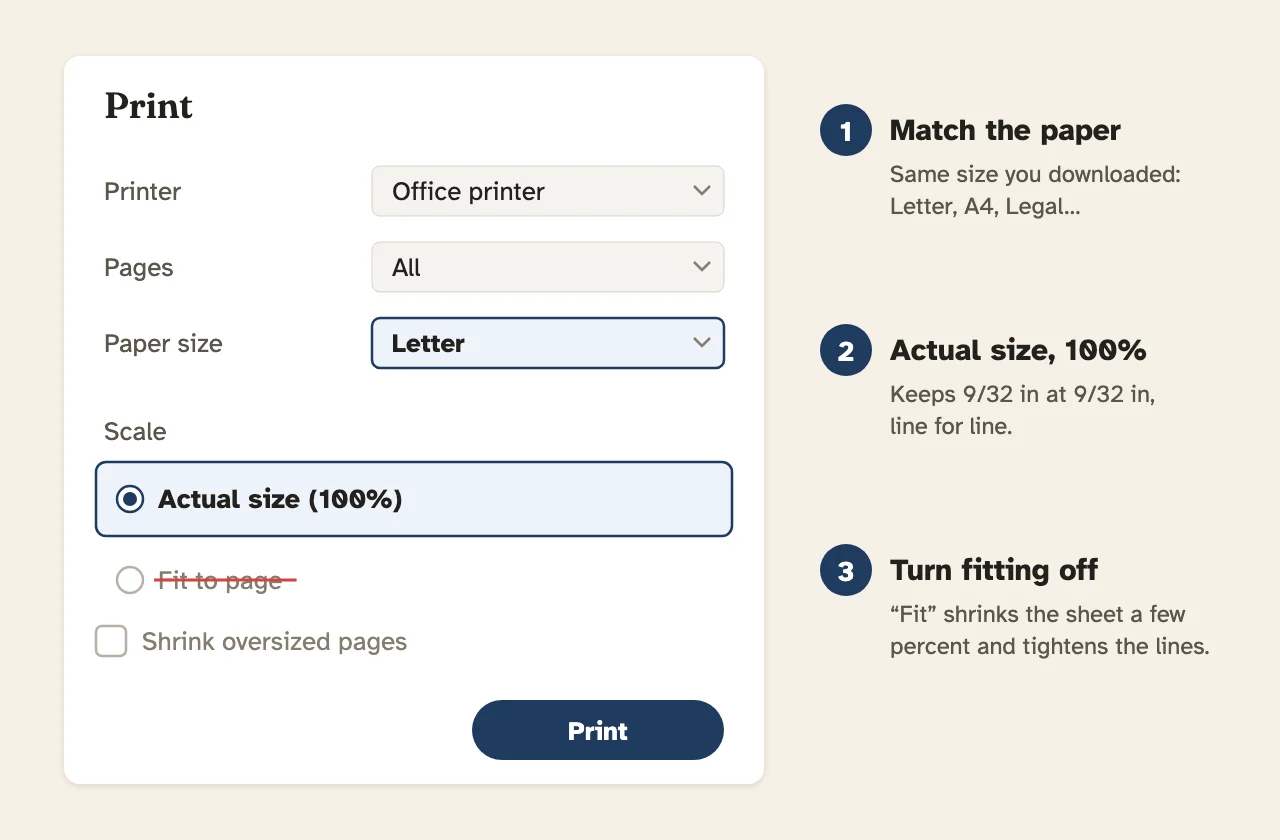
At 1/4 inch, a printer that scales the page by even a few percent is easy to notice: ten lines that should span 2 1/2 inches come out at 2 3/8, and the bottom lines drift off the page. Set Scale to Actual size (100%) in the print dialog, turn off Fit to page, and turn on the Print-check ruler for the first sheet. If the ruler measures one inch, the spacing is right.
Very light lines at Fine weight can break up on some inkjet printers in draft mode. If that happens, switch to Regular weight or print in normal quality. Laser printers handle fine lines well but sometimes print a shade lighter than the preview, so the darker blue is a safe choice for a stack you will photocopy again.
For loose pages headed to a binder, turn on Hole marks, or start from the notebook paper page where they are already on. If you would like notes with a cue column instead of plain lines, see the Cornell template linked above.
Narrow ruled paper has 1/4 inch between lines, which is 6.35 mm. It is the tightest of the three standard American rulings, after wide (11/32 inch) and college (9/32 inch).
A Letter sheet from this generator holds 39 narrow ruled lines. A4 holds 41, Legal holds 51, A5 holds 29 and Half Letter holds 30.
Close. 1/4 inch is 6.35 mm, so 6 mm lines are slightly tighter and give two or three more lines per page. Both feel the same to most writers.
Anyone whose lowercase letters are about 2.5 mm tall or smaller: people with small, neat handwriting, students writing a one-page study sheet, and planners or journals in A5 where space is short.
Yes. Click the closer arrow next to Line spacing to reach 6 mm and then 5 mm. At 5 mm a Letter page has 49 lines.
Use a fine or extra-fine nib. Broad nibs and wet inks spread on tight lines. Print on 24 lb (90 g/m²) paper so the ink does not bleed through.
It can be for large handwriting. If your letters touch the line above, step up to college ruled. Choosing a lighter line color, such as gray at Fine weight, also makes dense pages easier on the eye.
Yes. Set Margin to Both sides so the margin falls on the binding edge whichever way the page faces, then print with flip on long edge.