1/4 inch quad ruled
28 × 40 squares, bold every inch
Quad ruled 1/4 inch, 5 mm, 1 cm, millimeter and more. Choose the square size, bold lines and color, then download a true-size PDF. Free, no sign-up.
The six grids people print most. PDF prints Letter; the second button prints A4.
28 × 40 squares, bold every inch
38 × 50 on Letter, 36 × 54 on A4
Big boxes for younger children
1 mm with bold centimeter lines
Numbered x and y axes
15 × 20 squares for games and maps
Graph paper is only as useful as its squares are true. This page draws the grid as vector lines at the exact size you pick, from 1 mm up to 1 inch, and fits whole squares to your paper so nothing is cut off at the edge.
Each size below is a step on the square size arrows. The counts are what the generator fits inside half-inch margins, rounded down to whole squares and, when bold lines are on, to whole blocks.
| Square | Usually called | On Letter | On A4 | Good for |
|---|---|---|---|---|
| 1/4 in · 6.35 mm | Quad ruled, 4 per inch | 28 × 40 | 28 × 40 | Algebra graphs, floor plans, notes |
| 1/5 in · 5.08 mm | 5 squares per inch | 35 × 50 | 35 × 50 | Science labs, engineering work |
| 5 mm | Metric squared paper | 38 × 50 | 36 × 54 | School maths outside the US, journals |
| 1 cm · 10 mm | Centimeter grid | 19 × 25 | 18 × 27 | Young children, area and arrays |
| 1/8 in · 3.2 mm | Fine grid | 60 × 80 | 58 × 85 | Detailed sketches, small charts |
| 1 mm | Millimeter paper | 190 × 250 | 180 × 270 | Precise plots and lab graphs |
| 1/2 in | Large grid | 15 × 20 | 14 × 21 | Games, big diagrams, early grades |
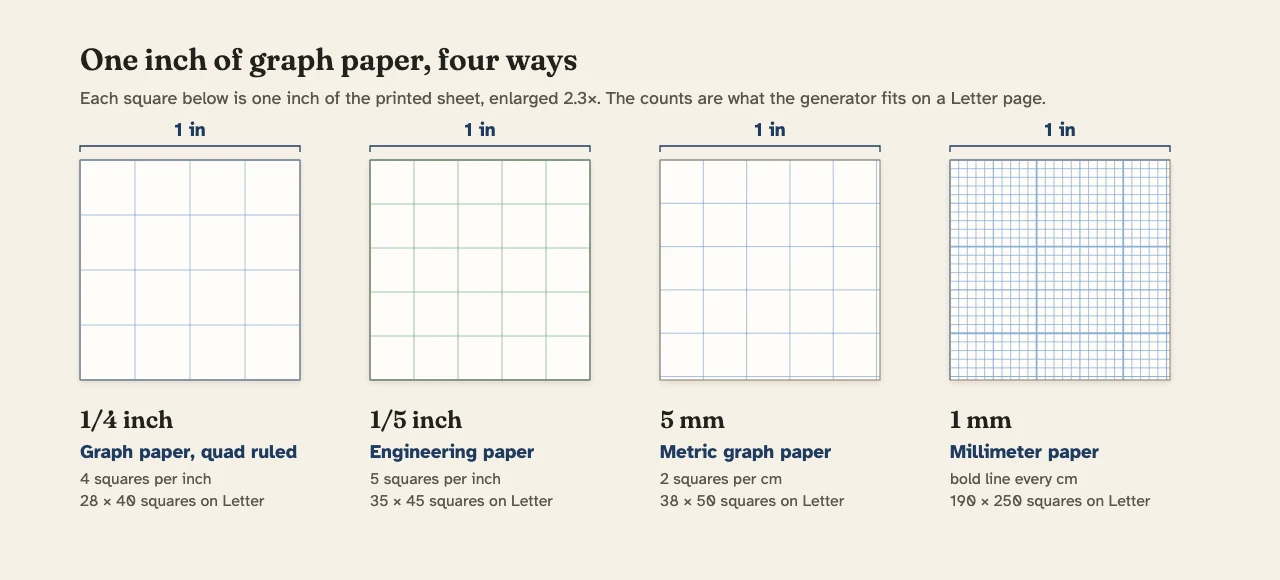
Start from what goes in each square. If you write a digit or a letter in every box, as in long division or a spelling grid, the square has to be at least as tall as your handwriting: 1/4 inch or 5 mm for adults and older students, 1 cm for children in the first grades.
If the squares are a scale and not a place to write, think about the units instead. A floor plan at 1/4 inch to the foot, a chart where each square is one unit, or a pixel art sprite where each square is one pixel all work best when the size divides your drawing evenly. Pick the size that makes your biggest number fit on one sheet.
For plotting data, finer is usually better. A millimeter sheet lets you read a value to a tenth of a centimeter, and the bold line every centimeter keeps your eye from getting lost. Turn on bold lines every 4 or 5 squares on coarser grids for the same reason: counting 37 thin squares is slow, counting seven blocks and two squares is not.
These names overlap, and shops use them loosely. A short guide:
The tabs above switch the same page to the rest of the graph paper family. Dot grid paper keeps only the corners of the squares, which is popular for journals and lettering. Isometric graph paper uses equilateral triangles for drawing objects in 3D. Polar graph paper has rings and angle lines for plotting in polar coordinates, and the Millimeter tab prints a full 1 mm sheet with bold centimeter lines.
Copy link to these settings saves your exact grid as a link you can bookmark or share with a class.
In the United States the standard is 1/4 inch, four squares to the inch, usually sold as quad ruled. Outside the US the usual sheet has 5 mm squares. This generator opens on 1/4 inch and steps from 1 mm up to 1 inch.
With half-inch margins, a Letter sheet holds 28 × 40 squares at 1/4 inch, 38 × 50 at 5 mm, 19 × 25 at 1 cm and 190 × 250 at 1 mm. A4 holds 28 × 40 at 1/4 inch and 36 × 54 at 5 mm. The count under the preview updates as you change size.
Quad ruled paper is graph paper with four squares per inch, so each square is 1/4 inch. The name comes from the four squares in every inch. Some notebooks print 5 per inch and still call it quad, so check the spacing if it matters.
Yes. Grid paper, graph paper, squared paper and quadrille paper all mean a sheet ruled with evenly spaced horizontal and vertical lines. The only thing that changes from sheet to sheet is the size of the squares and whether some lines are bolder.
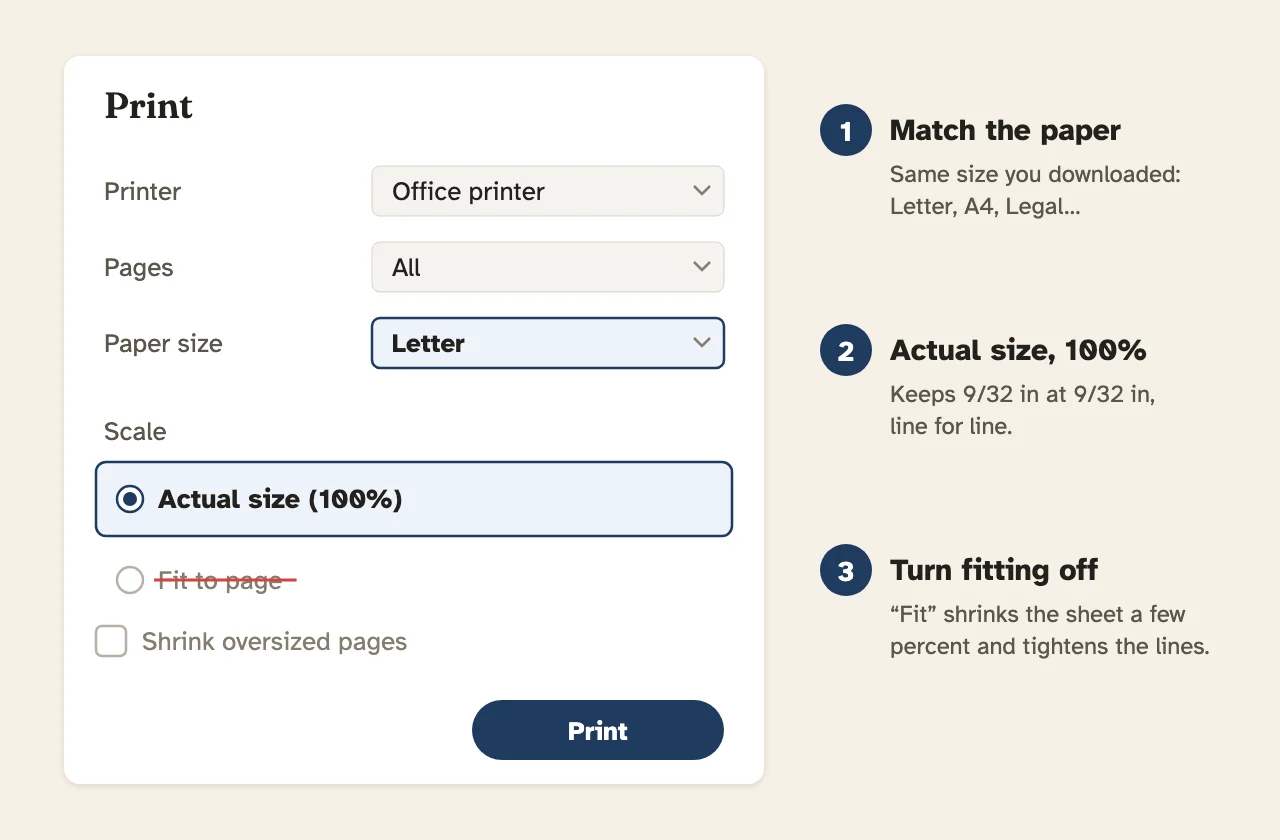
Print the PDF at Actual size or 100% scale, never Fit to page. Turn on Print-check ruler before downloading and measure the one-inch bar on your printout. If it is short, your print dialog is still scaling the page.
Yes. Use the 1 cm card, or pick 10 mm with the square size arrows. Letter fits 19 × 25 one-centimeter squares and A4 fits 18 × 27. Large squares like these suit young children, multiplication arrays and big drawings.
Quarter-inch paper is the usual choice, because 1/4 inch = 1 foot is a standard architectural scale. A 28 × 40 square Letter sheet then covers a 28 by 40 foot plan. For metric plans, 5 mm squares at 1:100 give half a meter per square.
Yes. Turn on x/y axes with numbers, or open the Coordinate tab. The generator draws both axes through the middle of the grid with arrowheads and numbers along them, which is ready for plotting points and lines.
Yes. Every sheet is free to print, copy and hand out to a class, with no sign-up and no watermark. The PDF is drawn as vector lines, so it stays sharp on any printer and you can put up to 100 pages in one file.