1 inch · Pre-K
6 big rows on Letter
Three-line rows with a red dashed midline, for children learning letter size. Choose a writing height from 1 inch for kindergarten down to 3/8 inch.
Each card is one writing height. PDF prints Letter; the second button prints A4.
6 big rows on Letter
8 rows on Letter
10 rows on Letter
13 rows on Letter
17 rows on Letter
Long rows for spelling
Handwriting paper gives every row three guides: a top line, a dashed midline and a bold baseline. Children see where each letter starts and stops, and the page prints at the exact height their program asks for.
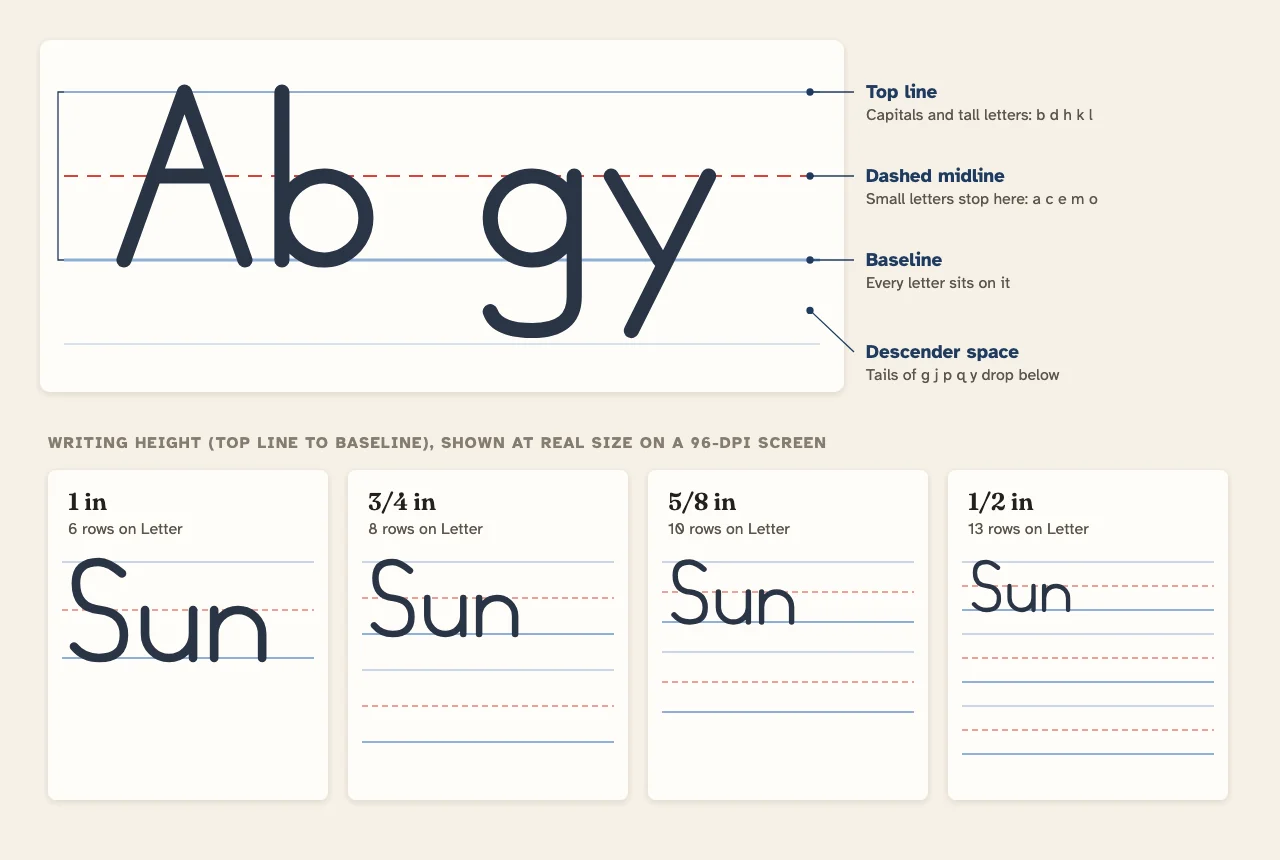
Every row on this page follows the same pattern, so a child learns one system and keeps it as the lines get smaller:
The writing height, the distance from top line to baseline, is the one setting that matters. Choose it under Writing height or with the arrows beside it.
| Writing height | Rows on Letter | Rows on A4 | Rows on Legal | Rows on A5 |
|---|---|---|---|---|
| 1 in · 25.4 mm | 6 | 7 | 8 | 5 |
| 7/8 in · 22.2 mm | 7 | 8 | 9 | 5 |
| 3/4 in · 19.1 mm | 8 | 9 | 11 | 6 |
| 5/8 in · 15.9 mm | 10 | 11 | 13 | 7 |
| 1/2 in · 12.7 mm | 13 | 13 | 17 | 9 |
| 3/8 in · 9.5 mm | 17 | 18 | 22 | 12 |
Only whole rows are drawn. A row appears only if its baseline fits above the half-inch bottom margin, so you never get a row cut in half. Taller rows mean fewer of them: going from 1/2 to 5/8 inch costs three rows on a Letter page.
Handwriting programs differ, so treat this as a typical path rather than a rule. If your school sends home a sample sheet, match its height with a ruler and pick the same size here.
| Stage | Typical writing height | Why |
|---|---|---|
| Pre-K and early kindergarten | 1 in or 7/8 in | Large movements from the shoulder, crayons and fat pencils |
| Kindergarten | 3/4 in | Letters forming, still large and uneven |
| Grade 1 | 5/8 in, then 1/2 in | Consistent letter size begins |
| Grade 2 | 1/2 in, then 3/8 in | Writing sentences and short paragraphs |
| Grade 3 | 3/8 in, then wide ruled | Midline no longer needed |
A child should move down a size when their letters sit inside the guides most of the time, not when the calendar says so. Going too small too early makes writing slow and tiring; staying too large for too long is rarely a problem.
The usual next step is wide ruled paper: one line per row, 11/32 inch apart, close to the 3/8 inch writing height a third grader has been using. From there students move to college ruled paper in middle school.
Older students who want to work on letter form, and not just size, can go on to calligraphy paper. It uses the same idea, top line, midline and baseline, plus a descender line and optional slant lines for italic and cursive. For letters to family once the handwriting is ready, try writing paper with a border and wide 3/8 inch lines.
Handwriting paper, also called primary paper or three-line paper, has rows of three lines: a solid top line, a dashed midline and a solid baseline. The midline shows where small letters stop, so children learn letter size as well as shape.
Most kindergartners start on a writing height of 3/4 inch or 1 inch, measured from the top line to the baseline. That gives 8 or 6 rows on a Letter page. Move down a size when letters fit comfortably and stop touching the lines.
First grade paper is usually 5/8 inch or 1/2 inch. At 5/8 inch a Letter page has 10 rows; at 1/2 inch it has 13. If your school’s handwriting program names a size, follow it.
The dashed line marks the height of small letters such as a, c, e, m and o without looking like a line to write on. Tall letters and capitals go up to the solid top line. Here the midline is printed red so it stands out from the blue lines.
Each row is followed by a gap half the writing height. Tails of g, j, p, q and y drop into it without running into the top line of the next row.
When their small letters are a consistent size without the midline, usually around grade 2 or 3. Start with 3/8 inch handwriting paper, then switch to wide ruled paper, which has the same 3/8-inch feel without the guide.
Yes. Set the page to landscape for longer rows: 6 rows at 3/4 inch on Letter, with room for a whole sentence per row. Landscape is popular for name practice and spelling words.
Yes. Type it in the Name field under the preview and it is printed on the name line of every page. Add a title, such as “Spelling words”, to label a practice set.
Yes. Adults relearning to write after an injury or stroke, people practicing a new script, and English learners all use it. The 3/8 or 1/2 inch heights suit adult hands best.