Guitar tab, 6 strings
8 tab staves per page
Tablature with a TAB clef on every staff. Pick 4, 5, 6 or 7 strings, 5 to 10 staves and bar lines, then download a true-size PDF. Free, no sign-up.
Guitar, bass and 7-string sheets. PDF prints Letter; the second button prints A4.
8 tab staves per page
4 measures on every staff
6 staves, 19.2 mm tall
Also fits ukulele
Five-string bass or banjo
Low B on the bottom line
Blank guitar tab is the quickest way to get a riff out of your head and onto paper. This sheet prints a TAB clef on every staff, one line per string, and even bar lines if you want them, for 6-string guitar, bass, banjo or 7-string.
Each line is a string and each number is a fret. Read left to right like text. Numbers in the same column are played together as a chord; numbers in a row are played one after another.
| Symbol | Meaning | Written as |
|---|---|---|
| 0 | Open string, no fret pressed | 0 on the line |
| 3 | Press the string at the 3rd fret | The fret number on the line |
| h | Hammer-on | 5h7 |
| p | Pull-off | 7p5 |
| / \\ | Slide up or down | 5/7, 7\\5 |
| b | Bend | 7b9 (bend to the pitch of fret 9) |
| ~ | Vibrato | 7~ |
| x | Muted or not played | x on the line |
Pick the number of lines to match your instrument. The top line is the first string: the high e on guitar, the G on bass. Banjo is the odd one out, with its short high g string on the bottom line.
| Strings | Instrument | Lines, top to bottom (standard tuning) | Staff height, 8 per Letter page |
|---|---|---|---|
| 6 | Guitar | e B G D A E | 14.4 mm, lines 2.9 mm apart |
| 7 | 7-string guitar | e B G D A E B | 14.4 mm, lines 2.4 mm apart |
| 4 | Bass guitar | G D A E | 14.4 mm, lines 4.8 mm apart |
| 4 | Ukulele | A E C G | Same 4-line sheet |
| 5 | Five-string bass | G D A E B | 14.4 mm, lines 3.6 mm apart |
| 5 | Banjo | D B G D g | Same 5-line sheet |
For alternate tunings like drop D or DADGAD, write the tuning at the start of the first staff, one letter beside each line, so you and anyone reading it play it right.
A tab page reads best when each line of music is a phrase you can play through:
| Tab staves per page | 6-string staff on Letter | Lines apart | Good for |
|---|---|---|---|
| 5 | 23.0 mm | 4.6 mm | First lessons, children |
| 6 | 19.2 mm | 3.8 mm | Big, easy-to-read tab |
| 8 | 14.4 mm | 2.9 mm | Songs with chords and rhythm |
| 10 | 11.5 mm | 2.3 mm | Long solos and practice logs |
On A4 every staff is about a millimeter taller. Leave more staves off the page when you add chord names, lyrics or rhythm marks: the space between staves grows with each one you remove.
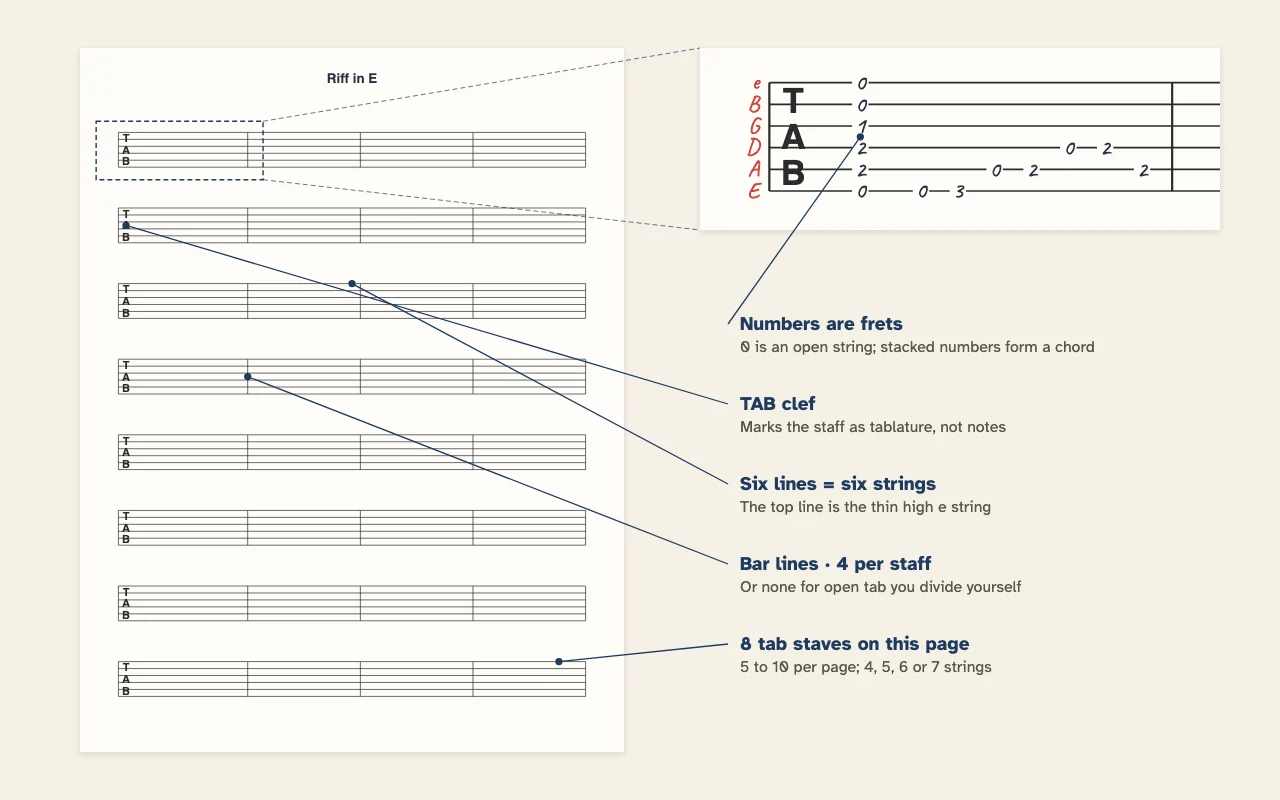
Guitar tab paper, or blank tablature, is music paper with one horizontal line for each string instead of the five lines of a music staff. You write a fret number on a line to show where to press that string. The TAB letters at the start mark it as tablature, not standard notation.
The top line is the thinnest, highest-pitched string, the high e. The bottom line is the low E. Tab is drawn this way so it matches looking down at the guitar on your lap: in standard tuning the lines from top to bottom are e B G D A E.
Stack the fret numbers in one column, one per string, and read them together. An open E major chord is 0 on the high e, 0 on B, 1 on G, 2 on D, 2 on A and 0 on the low E. Leave a string empty or mark it x when it is not played.
Yes. The Bass tab card prints four lines for a four-string bass, labeled G D A E from top to bottom in standard tuning. Pick 5 strings for a five-string bass with a low B, or for five-string banjo.
Yes. Set Strings to 7. Seven-string guitars usually add a low B under the low E, so the bottom line is B and the lines read e B G D A E B from the top.
Choose from 5 to 10 tab staves per page. On Letter, 8 six-string staves are 14.4 mm tall with the lines 2.9 mm apart, which leaves room for chord names above and rhythm marks below. Fewer staves give bigger lines for beginners.
They are playing techniques written between fret numbers: h is a hammer-on, p a pull-off, b a bend, / a slide up and \ a slide down. A ~ means vibrato, x a muted note and PM palm muting. Write them on the same line as the notes they connect.
Plain tab shows which notes to play but not how long they last. Write the count above the staff, add stems under the numbers, or keep the song in your ear. For exact rhythms, write the melody on staff paper as well.
Yes. Set Strings to 4. In standard ukulele tuning the lines from top to bottom are A E C G, so the top line is the A string closest to the floor when you hold the ukulele.