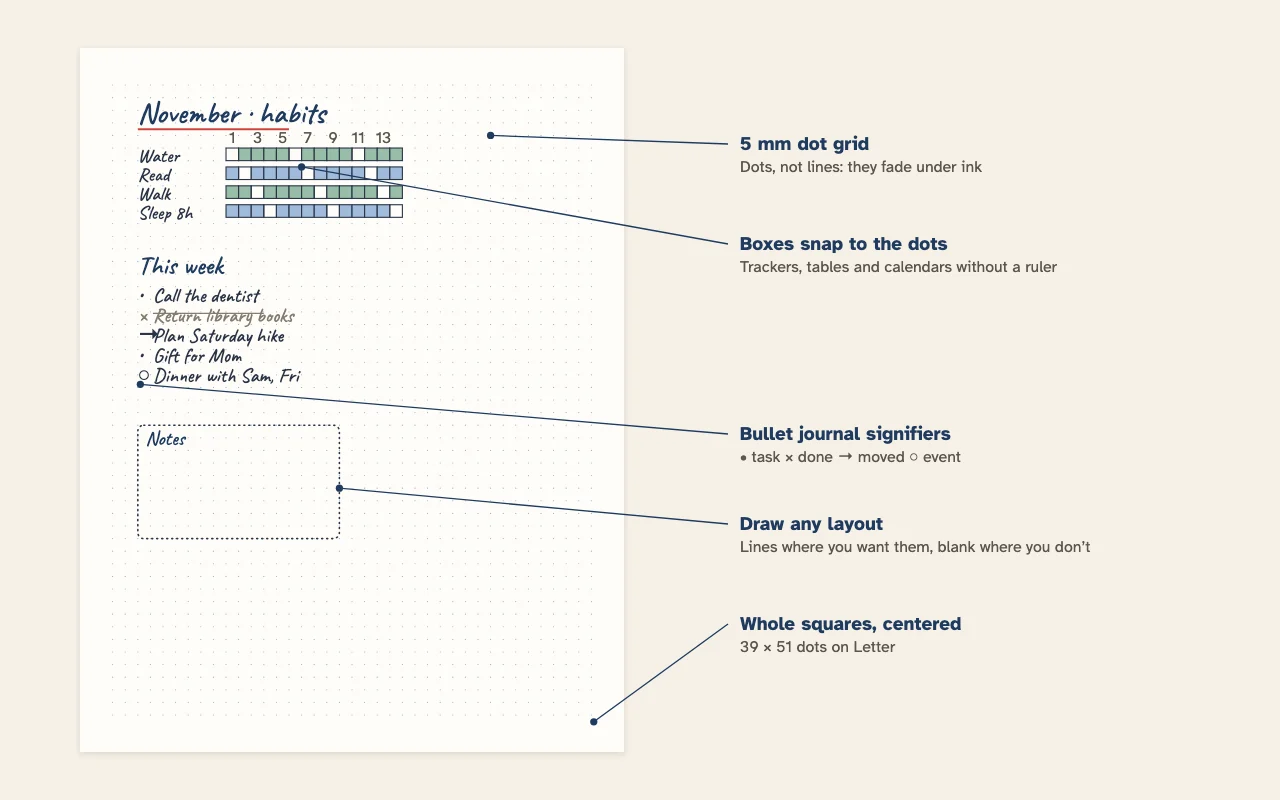
5 mm dot grid
39 × 51 dots on Letter
Dotted paper for bullet journals, lettering and sketching. Pick 5 mm, 1/4 inch or 1 cm dots and the page size, then download a true-size PDF.
The journal standard and five variations. PDF prints Letter (A5 on the journal card); the second button prints A4 (Half Letter on the journal card).
39 × 51 dots on Letter
27 × 39 dots, bullet journal size
Room for bigger handwriting
Math, games and young writers
39 × 49 dots under a header
51 × 39 dots for wide spreads
Dot grid paper keeps the corners of a grid and drops the lines. The dots line up your writing, boxes and sketches, then disappear under the ink. Pick the spacing and page size here and print sheets that fit your journal or binder.
The same dots work for a weekly list, a habit tracker, a sketch and a block of notes, all on one page. That flexibility is why dotted paper became the standard page for bullet journals.
| Dot spacing | Letter | A4 | Good for |
|---|---|---|---|
| 5 mm | 39 × 51 dots | 37 × 55 dots | Bullet journals, planners, everyday notes |
| 1/4 in · 6.35 mm | 31 × 41 | 30 × 43 | Larger handwriting, lettering practice |
| 4 mm | 48 × 64 | 47 × 68 | Small writing, dense layouts |
| 1/5 in · 5.08 mm | 38 × 51 | 37 × 54 | Inch-based diagrams, five dots per inch |
| 1/8 in · 3.2 mm | 61 × 81 | 59 × 86 | Fine sketching and UI wireframes |
| 10 mm · 1 cm | 20 × 26 | 19 × 28 | Math lessons, dots and boxes, kids |
Counts are dots, not squares, and fit inside half-inch margins. A dot grid always has one more dot than squares in each direction.
A bullet journal is a notebook you lay out yourself, page by page. The dots let you build a monthly calendar, a list or a tracker without a ruler, and you change the layout whenever your needs change. Common pages:
Most dotted journals are A5 with 5 mm dots. The A5 journal card prints exactly that, so loose printed pages match a store notebook. Print on 100 gsm paper or heavier if you use felt pens.
Each page style helps a different kind of work:
If you mostly write and sometimes draw, dots are the best compromise. If you mostly draw to scale, choose graph paper.
For triangle-based dots, open isometric paper and set Draw as to Dots.
Dot grid paper, also called dotted paper or dot paper, has small dots where the corners of graph paper squares would be, with no lines between them. You get the structure of a grid for lining up text, boxes and drawings, while the page still looks almost blank.
Five millimeters between dots is the usual spacing in dotted journals and the default here. A 5 mm sheet fits 39 × 51 dots on Letter, 37 × 55 on A4 and 27 × 39 on A5. For bigger handwriting, try 1/4 inch spacing.
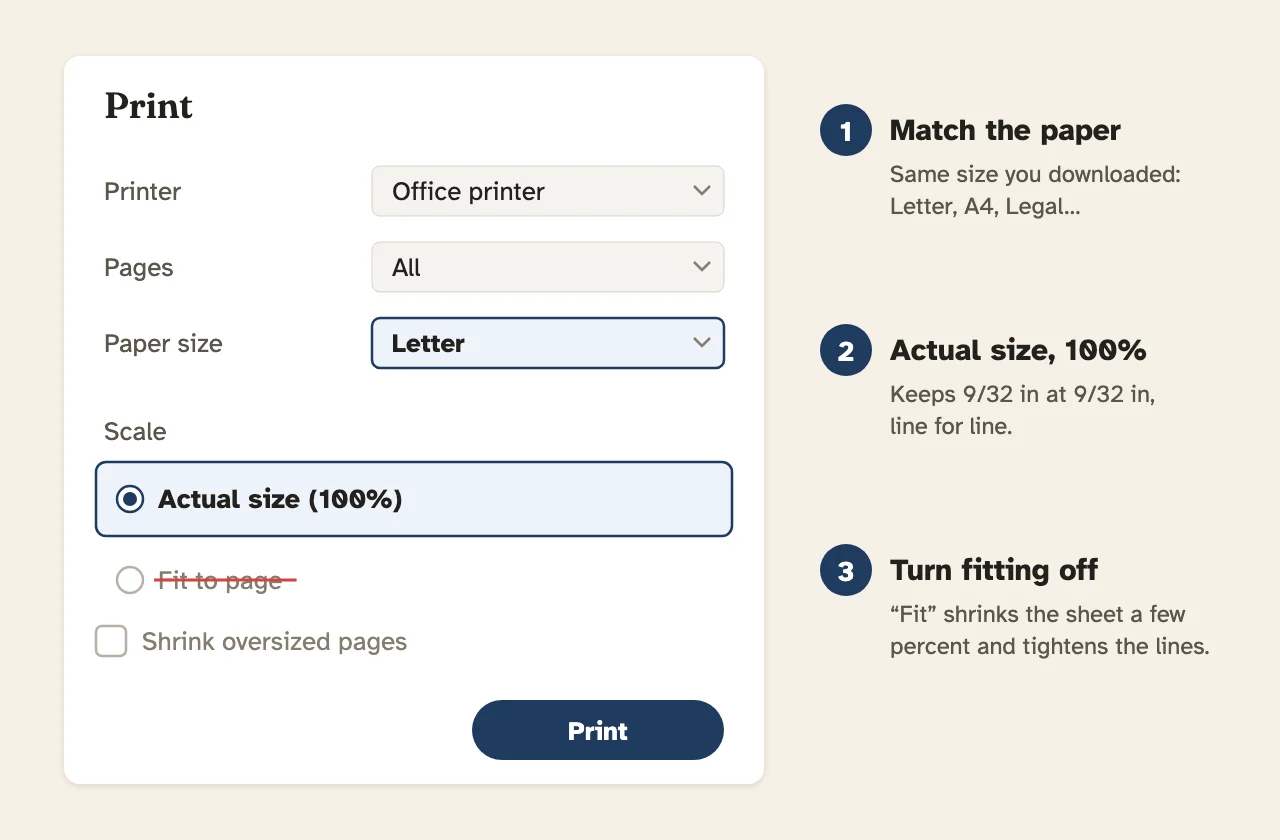
Use the A5 journal card or pick A5 in Paper size. The PDF is an A5 page, so print it on A5 paper, or print two to a sheet of A4 with your printer's pages per sheet setting and cut it in half. Check that scaling is off so the dots stay 5 mm apart.
It depends on the page. Dots work best when one page mixes writing, lists, tables and sketches, because they guide you without getting in the way. For pages of plain writing, lined paper is faster; for precise plots, graph paper is clearer.
Yes. Line weight changes the dot size: Fine gives small, quiet dots, Bold gives larger ones that copy well. Color changes how strongly they show; gray and light blue are faint behind ink, black is the most visible.
At 5 mm spacing with half-inch margins, Letter holds 39 × 51 dots and A4 holds 37 × 55. At 1/4 inch spacing Letter holds 31 × 41. Turning on the name and date line takes two rows off the top. The count under the preview always shows the current number.
Teachers use square dot paper like a paper geoboard: students join dots to draw polygons, find areas by counting squares, draw reflections and rotations, and explore Pick's theorem. For triangle-based shapes, isometric dot paper does the same job.
Yes. Large spacing such as 1/2 inch or 1 cm makes a good dots and boxes board. Players take turns joining two neighboring dots, and whoever closes a box writes their initial inside and moves again. One sheet holds dozens of games.
Yes. Print as many pages as you like, copy them for a class or bind them into a homemade journal. There is no sign-up and no watermark, and the PDF holds up to 100 pages.