Treble clef staff paper
12 staves, clef on each
Blank sheet music with treble, bass, piano or no clef, 6 to 14 staves and optional bar lines, title and composer. Download a true-size PDF. Free, no sign-up.
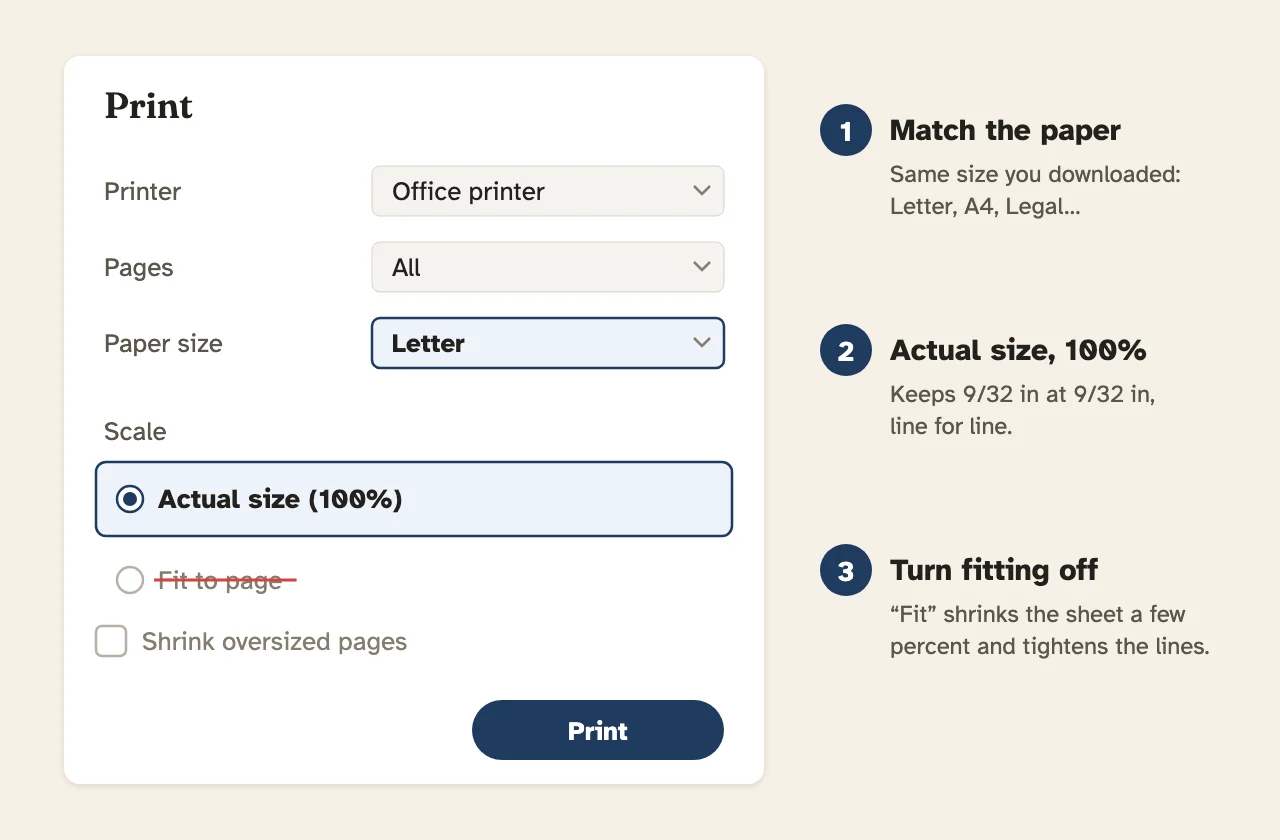
The four clefs, a large-staff page and guitar tab. PDF prints Letter; the second button prints A4.
12 staves, clef on each
For low instruments and left hand
6 systems with a brace
12 staves, no clef
6 staves, 17.5 mm tall
8 tab staves, 6 strings
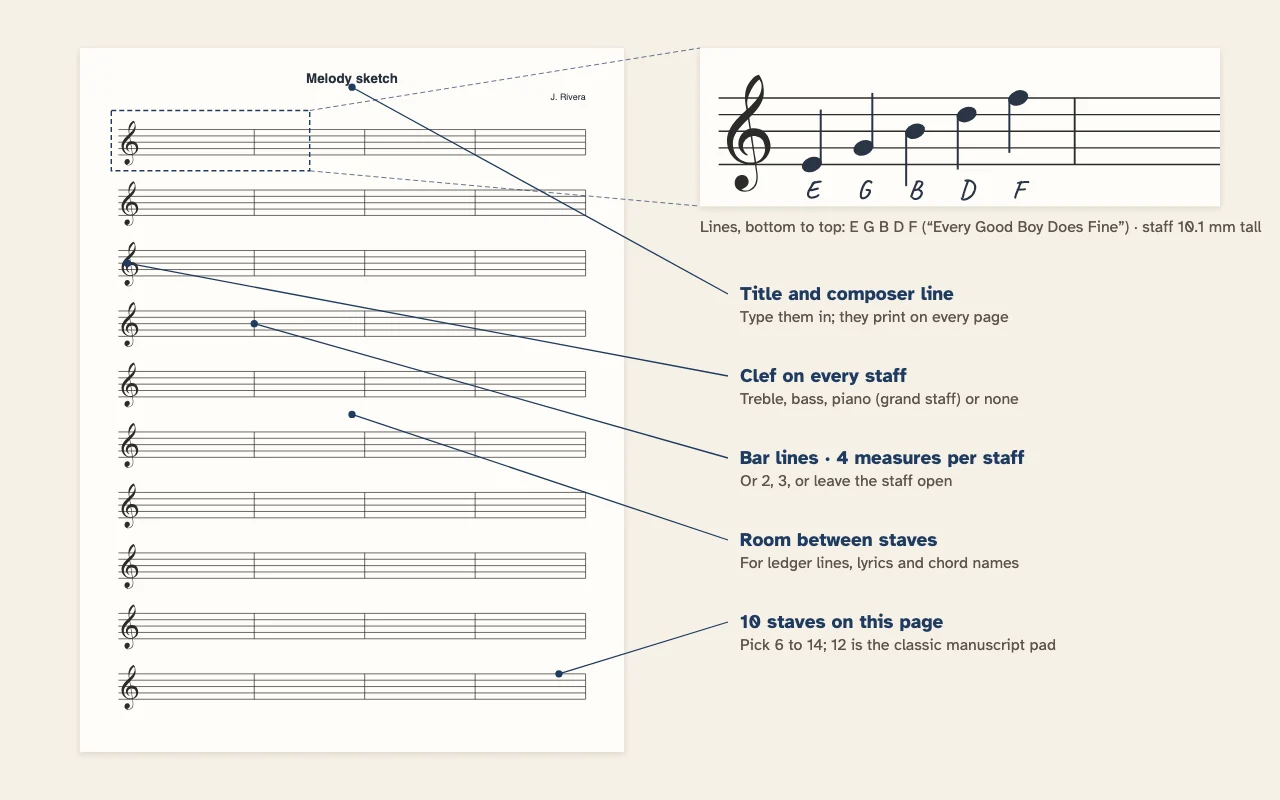
Staff paper is where music gets written down before it is anything else. This page prints clean manuscript paper with the clef already on each staff, even bar lines if you want them, and a title and composer line, in true size for Letter or A4.
A staff is five lines and four spaces. Each line and space is a pitch, the clef at the start says which, and bar lines split the staff into measures. Everything else on the page is room to write.
| Staves per page | Staff height on Letter | On A4 | Best for |
|---|---|---|---|
| 6 | 17.5 mm | 18.7 mm | Young beginners, big noteheads |
| 8 | 13.1 mm | 14.1 mm | Lessons, lead sheets with lyrics |
| 10 | 10.5 mm | 11.3 mm | Songwriting, room for chords and words |
| 12 | 8.8 mm | 9.4 mm | The standard manuscript pad |
| 14 | 7.5 mm | 8.0 mm | Sketches, theory exercises, many lines |
| 12, piano | 9.6 mm | 10.3 mm | 6 grand staff systems |
Staff height is measured from the bottom line to the top line. The space between staves grows as you choose fewer of them, which leaves room for ledger lines, dynamics, lyrics and chord names.
Middle C is one ledger line below the treble staff and one above the bass staff, so on a grand staff the two meet in the middle.
More staves fit more music on a page; fewer staves are easier to read and write. Pick by who is writing and what goes between the staves:
Writing for guitar or bass? Guitar tab paper has the TAB clef and 4 to 7 string lines.
Staff paper, also called manuscript paper or blank sheet music, is paper printed with sets of five horizontal lines called staves. Musicians write notes on the lines and in the spaces between them. This generator adds clefs, bar lines, a title and a composer name if you want them.
Twelve staves per page is the classic manuscript pad. Choose 10 for more room between staves for lyrics and ledger lines, 8 or 6 for beginners and children, and 14 for dense sketches. A piano page with 12 staves holds 6 grand staff systems.
On a Letter page with 12 staves, each staff is 8.8 mm tall from bottom line to top line. With 10 staves it is 10.5 mm, with 8 it is 13.1 mm, and with 6 it is 17.5 mm. A4 pages are slightly taller, so every staff is a little larger. Adding a title shrinks them by a few tenths of a millimeter.
Print treble clef for violin, flute, oboe, clarinet, trumpet, guitar and most voices. Print bass clef for cello, double bass, bassoon, trombone, tuba and bass guitar. Print the piano grand staff for piano, harp and keyboard. Leave the clef off for viola, percussion or when you need several clefs.
A grand staff is a treble staff and a bass staff joined by a brace and a line at the left edge. Piano music uses it: the right hand usually plays from the top staff and the left hand from the bottom. Middle C sits on a ledger line between the two staves.
On the treble staff the lines from the bottom are E G B D F (Every Good Boy Does Fine) and the spaces spell FACE. On the bass staff the lines are G B D F A (Good Boys Do Fine Always) and the spaces are A C E G (All Cows Eat Grass).
Yes. Set Bar lines per staff to 2, 3 or 4 and the generator divides every staff into equal measures, starting after the clef. Leave it at None to draw your own bar lines for measures of different lengths.
Yes. Type into Title on the page and Your name. The title prints centered at the top of every page and the name prints at the top right, where a composer or arranger name usually goes.
Yes. Print as many pages as you need, copy them for students or a choir and use them for any music you write. There is no sign-up and no watermark, and one PDF can hold up to 100 pages.